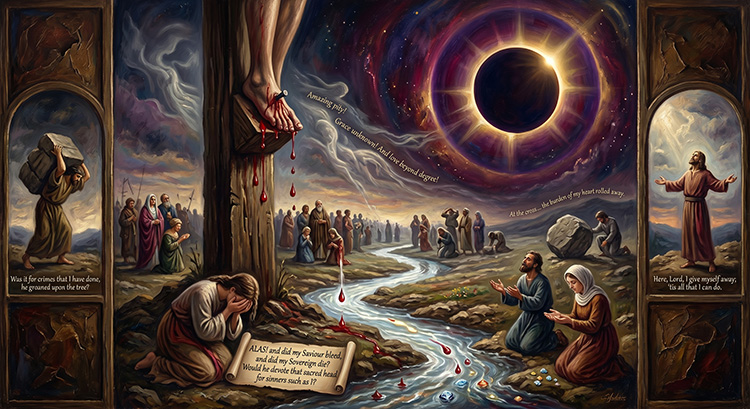
1. Alas! and did my Saviour bleed,
And did my Sovereign die?
Would He devote that sacred head
For sinners such as I?
2. Was it for crimes that I have done
He groaned upon the tree?
Amazing pity! grace unknown!
And love beyond degree!
3. Well might the sun in darkness hide,
And shut his glories in,
When God, the mighty Maker, died
For man the creature's sin.
4. Thus might I hide my blushing face
While His dear cross appears;
Dissolve my heart in thankfulness,
And melt mine eyes to tears.
5. But drops of grief can ne'er repay
The debt of love I owe;
Here, Lord, I give myself away-
'Tis all that I can do.
1707
Story of the hymn Alas! and Did My Saviour Bleed
Story of Alas! and Did My Saviour Bleed
Written by Isaac Watts, the "father of English hymnody"
Also known as "At the Cross"
Originally written as a poem
Date: 1707
Alas! and Did My Saviour Bleed - Details
Listen:
The Story Behind "Alas! and Did My Saviour Bleed"
Isaac Watts published "Alas! and Did My Saviour Bleed" in 1707 in his groundbreaking collection Hymns and Spiritual Songs (Book 2, on "Divine Subjects"). It originally appeared with
six four-line stanzas under the heading "Godly sorrow arising from the sufferings of Christ." The hymn was not inspired by a single dramatic personal event but by deep meditation on
the crucifixion of Jesus—reflecting on the astonishing mercy of God in dying for unworthy sinners.
Musical History and the "At the Cross" Version
Watts wrote the text as a poem; it was sung to various tunes over the years. One early popular melody was the Scottish tune Martyrdom (attributed to Hugh Wilson around 1800, later
adapted by Robert A. Smith).
In America, the hymn gained even greater popularity in the gospel tradition. In 1885, evangelist, singer, and composer Ralph E. Hudson (1843–1901) published a version in his collection
Songs of Peace, Love, and Joy. Hudson added a lively refrain and composed a new tune (now called HUDSON) for the verses, creating the familiar gospel-style hymn often titled "At the Cross":
Lasting Impact
The hymn has touched countless lives. A notable story involves Fanny Crosby (the famous blind hymnwriter). In the early 1850s (accounts vary slightly between 1850–1851), while
struggling with her faith at a revival meeting in a New York Methodist church, she heard this hymn sung. When the line "Here, Lord, I give myself away" was reached, she experienced a
profound spiritual breakthrough: "My very soul was flooded with a celestial light", leading to her conversion and lifelong commitment to Christ.
Today, "Alas! and Did My Saviour Bleed" continues to be sung in both traditional and gospel arrangements. It serves as a powerful reminder of the cost of redemption and the appropriate
response of total surrender to the Savior who bled and died.
Alas! and Did My Saviour Bleed - Video
Sing along on YouTube:
Alas! and Did My Saviour Bleed - Devotional
Opening Prayer
Lord Jesus, I come before You with a humbled heart. As I reflect on Your sacrifice, open my eyes to see the depth of Your love and the seriousness of my sin. Let the truth of
the cross soften what has grown hard, awaken what has grown dull, and strengthen what has grown weak. Draw me near to You as I meditate on Your mercy. Amen.
Scripture Foundation
Isaiah 53:5
“But he was wounded for our transgressions, he was bruised for our iniquities. The chastisement for our peace was upon him, and with his stripes we are healed.”
Reflection
Isaac Watts wrote “Alas and Did My Savior Bleed” as a personal meditation on the cross, and the hymn invites us into that same honest self-examination. The opening question is not
casual. It is the cry of someone who suddenly sees the weight of sin in the light of Christ’s suffering. Watts does not rush past the sorrow of the cross. He lets us feel the shock
that the Lord of glory would bleed for people who had nothing to offer Him.
Yet the hymn does not leave us in guilt. It moves us toward wonder. The One who suffered did so willingly. The One who hung in darkness did so out of love. The One who bore the curse
did so to bring us into blessing. Watts leads us to the turning point of grace. He shows us that the cross is not only a place of judgment but also a place of joy, because it is where
mercy triumphs.
As the hymn reaches its final verses, the tone shifts from sorrow to devotion. The heart that once asked “Was it for crimes that I have done?” now responds with gratitude.
Love awakens love. Christ’s sacrifice calls forth a life offered back to Him. Watts reminds us that true worship is not just singing but surrender. It is the giving of the heart,
the will, and the whole self to the One who gave everything for us.
Today, let the cross draw you again. Let it humble you, comfort you, and reshape you. Let it remind you that you are deeply known, deeply loved, and fully redeemed.